Only one in six households in Germany has an adequate emergency supply for a crisis. This shows that the biggest hurdle is often not a lack of knowledge, but simply getting started and deciding how best to prepare.
The Federal Office of Civil Protection and Disaster Assistance (BBK) is the central authority for recommendations on emergency preparedness in Germany. It recommends that every household should be prepared to remain self-sufficient for at least ten days, with three days considered the absolute minimum for getting started.
The real question, therefore, is not whether you should prepare, but how: should you buy a ready-made emergency kit or assemble one yourself? Both approaches have their advantages. This article compares them in detail, including the specific quantities recommended by the BBK.
What Belongs in an Emergency Kit? The Most Important Categories and Recommended Quantities
Regardless of whether you buy an emergency kit or assemble one yourself, the essential categories remain the same. For a ten-day supply per person, the BBK provides the following recommended quantities:
- Water: 20 litres per person (2 litres per day – approximately 1.5 litres for drinking and 0.5 litres for cooking)
- Grain products: 3.5 kg – bread, pasta, rice, oatmeal, crispbread
- Vegetables & legumes: 4.0 kg – e.g. canned peas, sweetcorn, tomato paste
- Fruit & nuts: 2.5 kg – dried, stewed or canned
- Dairy products: 2.6 kg – UHT milk, cheese, and, where appropriate, milk powder
- Meat, fish & eggs: 1.5 kg – canned or preserved in jars
- Fats: approx. 0.4 kg – oil, butter, margarine, nuts
This amounts to approximately 14–15 kg of food per person, calculated on the basis of around 2,200 kilocalories per day. In addition, an emergency supply should include a first-aid kit, hygiene products, as well as means of receiving information, such as a battery-powered or hand-crank radio, and communication equipment.
If one of these categories is completely missing, this creates a genuine gap in the emergency supply – not merely an inconvenience.
Buying an Emergency Kit: Advantages of a Ready-Made Set
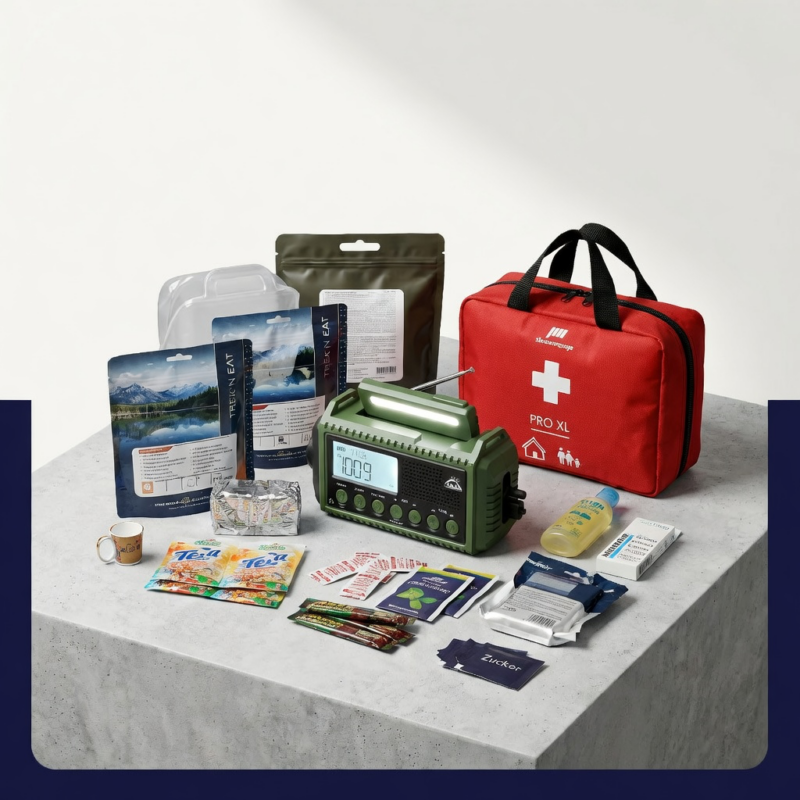
A ready-made emergency kit such as the BSSD Defence Emergency Kit for Home is already assembled according to the BBK recommendations and provides basic supplies for 72 hours. The biggest advantage is that it is ready to use immediately. There is no research required, no need to source individual items, and no risk of overlooking an important category.
Ready-made kits for one to two people generally cost between €200 and €300 and can be delivered within a few days. This makes a ready-made emergency kit particularly practical for anyone approaching emergency preparedness for the first time, who has little time for research or simply wants a tested solution ready in a cupboard – for example, at a second home or in a vehicle.
Assembling an Emergency Kit Yourself: Advantages of an Individual Solution
If you assemble an emergency kit yourself, you have complete control over every individual category: quantity, brand and quality level – all tailored to your household. When putting together your own supply, it is advisable to calculate the BBK quantities directly according to the number of people in the household: 20 litres of water per person becomes 80 litres for a family of four and 40 litres for a couple – a calculation that a ready-made kit in a fixed size cannot accommodate.
This is particularly worthwhile for:
- Larger households (3+ people), where water and food quantities need to be multiplied accordingly without necessarily having to purchase duplicate equipment such as radios or tools
- Special dietary requirements – gluten-free diets, diabetes-friendly food, baby food
- Households with pets, which need to plan additional water and food supplies
- People who already own emergency equipment and only want to supplement specific missing categories
Building an Emergency Supply: What Is Often Forgotten
Even when assembling a supply carefully, certain gaps are easily overlooked:
- Medication supplies – particularly medication taken regularly; ideally enough for the full ten-day period
- Cash in small denominations – card payments and ATMs may not work during a power outage
- Sufficient batteries for radios and flashlights, regardless of the devices themselves
- Hygiene products beyond the basic supplies – dental care products, wet wipes, rubbish bags
- Additional water for food preparation if dry products such as pasta or rice are included in the supply
A simple rule of thumb helps: go through the categories one by one, using the BBK quantities as a guideline rather than checking product by product. This helps ensure that nothing is overlooked.
Buying an Emergency Kit or Assembling One Yourself: Cost and Time
A ready-made kit generally costs €200–300 for one to two people and can be delivered within a few days. Assembling your own kit requires more time – for researching and purchasing individual products across seven categories – but it also gives you the opportunity to save in specific areas (e.g. dry foods) or invest selectively in others (e.g. a higher-performance water filter), rather than paying a fixed price for everything.
Who Benefits Most from Each Option?
The individual household or couple living in an urban apartment – limited storage space and little time for research. A ready-made emergency kit covers the household’s basic needs without having to deal with seven product categories and extensive quantity calculations.
Families with more than two people – require significantly more water and food (e.g. 80 rather than 20 litres of water for four people), but do not necessarily need duplicate equipment such as radios or tools.
Second homes or holiday homes – a ready-made kit can simply be stored on site without having to conduct separate research for each location.
Households with special requirements – allergies, pets or medication requirements are situations in which individual selection can be particularly beneficial.
Frequently Asked Questions About Emergency Kits
What belongs in an emergency kit? At a minimum, 2 litres of water per person per day, food providing around 2,200 kcal per day (divided among grain products, vegetables, fruit, dairy products, meat/fish and fats), a first-aid kit, hygiene products, and means of receiving information and communication, such as a battery-powered radio.
How much water is needed in an emergency? The BBK recommends 2 litres per person per day – for a ten-day supply, this means 20 litres per person. More should be planned for children, high temperatures or specific health-related requirements.
How long should an emergency kit last? The BBK recommends being prepared to remain self-sufficient for at least ten days. An emergency supply for 72 hours is a practical starting point, but it does not cover the full recommendation.
How much does an emergency kit cost? Ready-made emergency kits for one to two people generally cost between €200 and €300. An individually assembled kit may be cheaper or more expensive, depending on the products selected.
Should you buy an emergency kit or assemble one yourself – which is better? There is no universal answer. A ready-made kit is suitable for a quick and uncomplicated start. Assembling your own kit is preferable when special requirements need to be covered or when the household size differs from the standard configuration of a ready-made kit.
Conclusion
Whether you buy an emergency kit or assemble one yourself, the important thing is to be prepared at all – and with the right quantities: 20 litres of water, approximately 14–15 kg of food and the appropriate equipment per person for ten days. A ready-made kit takes the decision-making out of the process and is ready for immediate use. Assembling your own kit takes more time, but allows every category to be tailored precisely to your individual needs.
Our BSSD Defence Emergency Kit follows the BBK recommendations and provides a solid starting point – either as a complete solution or as a foundation that can be individually supplemented.
→ View the BBK Checklist

 Deutsch