Deutsch

Knowledge
Bunker Door, Armored Door, Blast Door: Which Door Protects Against What?
A shelter wall is made of reinforced concrete. The door interrupts this wall, and this is precisely where pressure, debris and hazardous substances reach it first. That is why there is no single type of bunker door. There are doors for the outer shell, emergency exits, airlocks and interior walls, each designed to withstand different loads.
The terms bunker door, shelter door and armored door are often used interchangeably. They generally refer to a heavy steel door for a shelter. This article explains which door protects against what, where it belongs and what is involved in installing it.
What does a bunker door need to protect against?
According to the German Federal Office of Civil Protection and Disaster Assistance (BBK), explosions pose major risks primarily due to blast waves, flying debris and fragments. Fire and, depending on the situation, hazardous substances are additional threats. An ordinary door cannot withstand any of these forces. A shelter door must be able to withstand them all simultaneously.
Five examples:
A nearby explosion (blast wave). For example, a gas accident or an impact in the street. The blast wave hits the door first. An armored door therefore opens outwards: the wave presses it more firmly into the frame instead of forcing it open.
Debris and fragments. For example, if the building above the shelter partially collapses. The solid steel door leaf withstands the impact. If debris blocks the exit, an optional self-release mechanism helps you open the door anyway.
Fire and heat. For example, a fire in the building above. The thick steel-and-concrete construction keeps the heat out.
Vibrations and shocks. For example, when the ground shakes after an impact. The lever locks are secured against accidental opening, even during pressure surges and ground shocks.
Hazardous substances and radiation. For example, in the event of a chemical accident or radioactive fallout. The rubber seal closes tightly all the way around. Combined with a filtered ventilation system that creates slight positive pressure inside the room, it keeps contaminated air out. You can find out how this works in the article Bunker Ventilation and Filtration. The thick door also reduces radiation.
What does “bar” mean for shelter doors?
The bar is the unit used to measure the pressure of an explosion. The higher the figure, the more pressure the door can withstand.
For example: At 1 bar, approximately 15 tonnes of force act on a door measuring 80 × 185 cm. That is equivalent to the weight of around ten cars. At 3 bar, the force is approximately 45 tonnes.
When comparing doors, it is worth looking at how they were tested. Was the door tested with a brief blast or with sustained pressure? This makes a difference.
What types of shelter doors are available?
We offer four types. The following explains what each one is designed for. You can find the weights and prices in the table below.
Armored Door (PT)
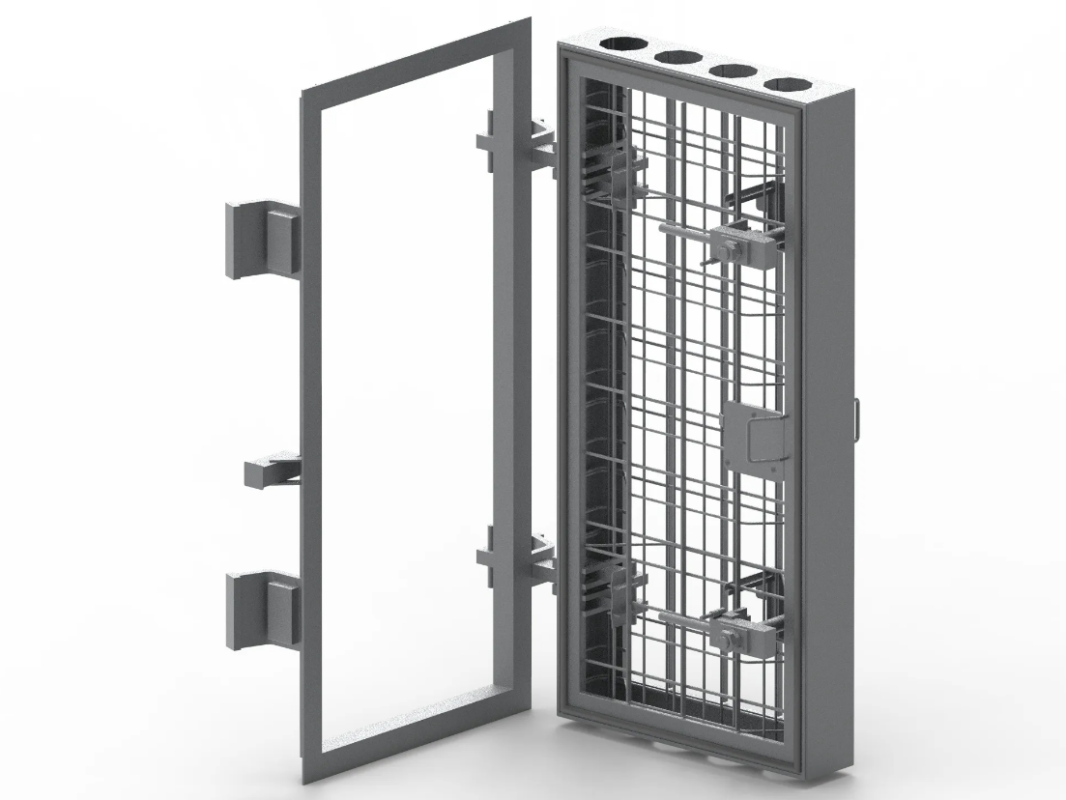
Where it belongs: In the outer shell of the shelter, as the main or secondary entrance.
What it is made of: The door leaf consists of a 20 cm-thick steel profile with welded-in reinforcement. It also includes an angle-steel frame with anchors, a continuous rubber seal and two lever locks. The door leaf is supplied without concrete and is filled with concrete on site.
What it protects against: The armored door is the strongest door in this range and is designed for a protection level of 3 bar. It withstands blast waves, debris, vibrations and heat.
Blast Door (DT)
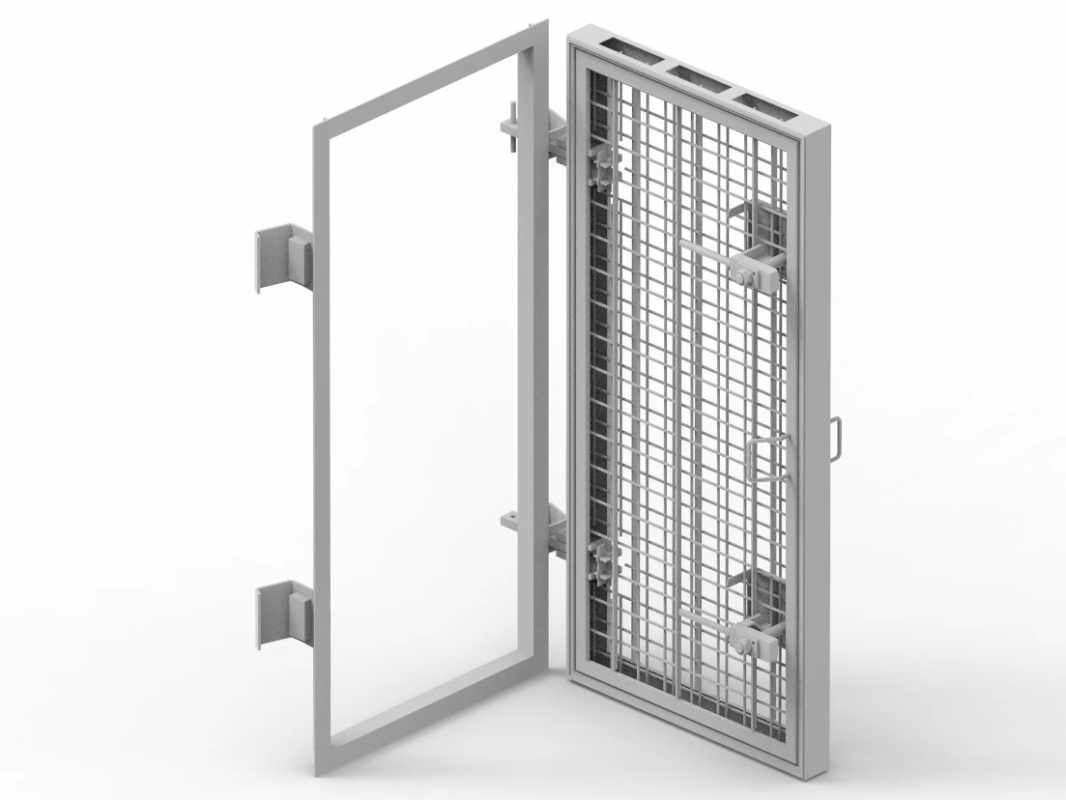
Where it belongs: In airlocks, interior walls and access points within the facility.
What it is made of: The door leaf consists of a 10 cm-thick steel profile with reinforcement and a continuous seal. The door can be configured to open either to the left or to the right.
What it protects against: The blast door is the lighter option for interior areas. It withstands pressure such as that generated by a gas or dust deflagration, but it is not designed for the outer shell.
Armored Hatch (PD)
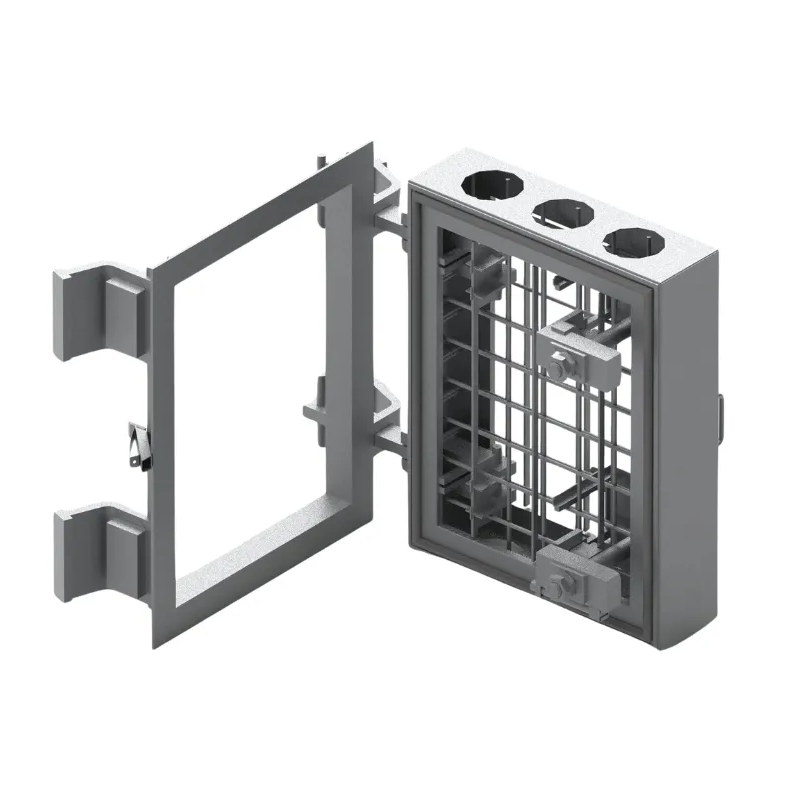
Where it belongs: As the external closure of emergency exits.
What it is made of: A steel frame with anchor plates, a hatch leaf with a seal and reinforcement, and lever locks. The clear opening measures 60 × 80 cm, and the hatch is inward-opening.
What it protects against: It is designed for protective structures rated at 1 and 3 bar. An optional self-release mechanism allows the emergency exit to be opened even if debris is blocking it. Additional accessories include a glazed tilting panel, rodent mesh, electric locking, signalling and a peephole.
Explosion-Protected Doors (BD-1, BD-3, RD-1)
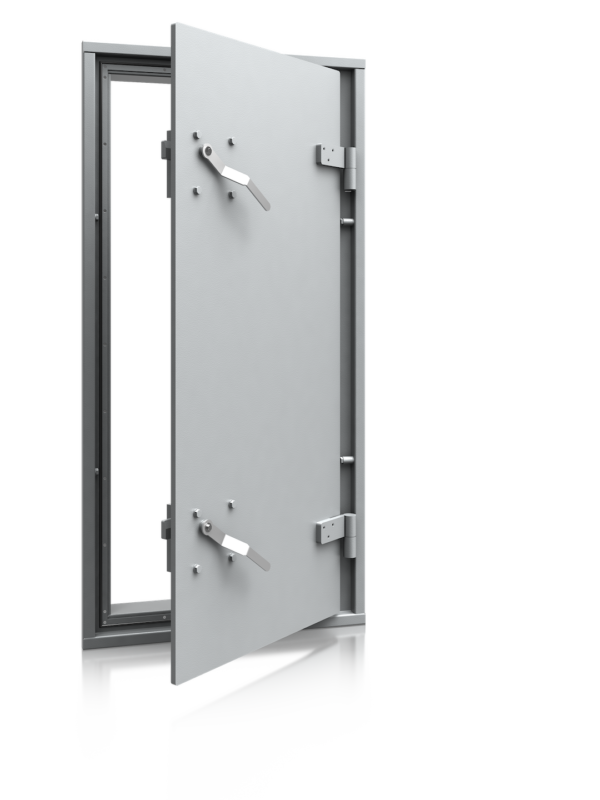
These are not conventional shelter doors. They are designed for facilities where an explosion may occur or where protection against an explosion is required. The Fraunhofer Institute for High-Speed Dynamics, Ernst-Mach-Institut (EMI), tested them using a shock tube in accordance with standard EN 13123-1. The class (EPR) indicates the pressure the door can withstand: the higher the number, the greater the pressure.
- BD-1: Class EPR2, tested at over 1 bar. Multi-layer door leaf, multi-point locking with 38 mm-diameter bolts, threshold-free design with a movable bottom seal. Designed for strategic facilities, critical infrastructure, storage facilities and laboratories. Approx. 250 kg.
- BD-3: Class EPR4, tested up to 3 bar, the highest rating in this range. 20 mm-thick door leaf, two-point locking. Designed for shelters, military storage facilities and industrial plants with the highest requirements. Approx. 425 kg.
- RD-1: Class EPR2, tested at over 1 bar, with additional RC4 burglary resistance. Designed for server rooms, weapons storage facilities, laboratories and critical infrastructure. Approx. 275 kg.
All three have a clear opening of 900 × 2000 mm.
Comparing the doors
| Door | Protection level | Weight (without concrete) | Typical application | Price from |
| Armored Door PT1/PT2 | 3 bar | Approx. 200 / 220 kg | Main and secondary entrances | €4,165.00 |
| Armored Hatch PD | 1 and 3 bar | Approx. 140 kg | Emergency exit | €2,996.50 |
| Pressure Door DT1/DT2 | 3 bar | approx. 115 / 125 kg | Airlock, inner wall | 5,500.00 € |
| BD-1 | Over 1 bar (25 ms) | Approx. 250 kg | Critical infrastructure, laboratories
|
€4,990.00 |
| BD-3 | 3 bar (20 ms) | Approx. 425 kg | Shelter, industrial facilities | €4,990.00 |
| RD-1 | Over 1 bar (25 ms) + RC4 | Approx. 275 kg | Server rooms, weapons storage | €9,900.00 |
Which door belongs where?
For example, a basement shelter with one entrance and one emergency exit requires an armored door for the entrance and an armored hatch for the emergency exit. If an airlock is added, it is separated from the shelter by a blast door. BD and RD explosion-protected doors are suitable where a building or facility needs to be protected against explosion overpressure.
The required protection level for your shelter is determined during the planning process, not by the door itself.
How is a shelter door installed?
The door is placed in the wall formwork in its closed position and cast into the concrete. The door leaf is then filled with concrete. Both steps should be carried out by specialists. We offer installation and supply the appropriate installation kit.
What is included in the installation kit?
To save you from having to source the materials individually, an installation kit is available with the doors. It contains everything needed for formwork, fastening and concrete, and is tailored to your door. The price depends on the door. You can select the kit and the size together on the product page.
Can a door be installed retrospectively?
Yes, this is possible. However, it is a complex process and should only be carried out by specialists, as there are many potential installation errors. The easiest option is to install the door while the wall is being built. We can carry out the installation for you on request.
What should you look out for when buying?
- Clear opening and hinge side: The dimensions (80 × 185 or 100 × 185 cm) and the hinge side, left or right, must match the plans.
- Opening direction: Armored doors open outwards, armored hatches open inwards, and blast doors can open in either direction.
- Protection level: This depends on the installation location. The outer shell, emergency exit and interior wall require different types of doors.
- Testing and approval:Our armored doors, blast doors and armored hatches are manufactured in accordance with the requirements of the Swiss Federal Office for Civil Protection (FOCP) and are approved by the BZS. The explosion-protected doors have been tested by the Fraunhofer Institute.
- Weight: The doors weigh between 115 and 425 kg. Transport and installation require assistance.
- Delivery time: 2 to 4 weeks.
Frequently Asked Questions
How much does a bunker door cost?
The price depends on the type. The armored hatch starts at €2,996.50, the armored door at €4,165.00, the BD doors cost €4,990.00, the blast door starts at €5,500.00 and the RD-1 costs €9,900.00. The installation kit and shipping are additional. Current prices are listed in the shop.
How much does an armored door weigh?
The PT1 weighs approximately 200 kg, while the PT2 weighs approximately 220 kg.
What does a shelter door protect against?
Depending on the type, it protects against blast waves, debris, vibrations, heat and radiation. Protection against hazardous substances is provided in combination with a filtered ventilation system.
What is an explosion-resistant door?
It is a door tested to withstand a specific level of explosion overpressure. The BD and RD doors were tested by the Fraunhofer Institute.
Can I install a bunker door myself?
We advise against it. Installation is complex and there are many potential sources of error. A door only provides protection if it is installed correctly. For this reason, installation should be carried out by specialists. We offer installation and supply the appropriate installation kit together with the door.
You can find all doors in the shop under Doors and Emergency Exits.