Deutsch

Knowledge
Shelter Supplies: What Should Be in a Shelter?
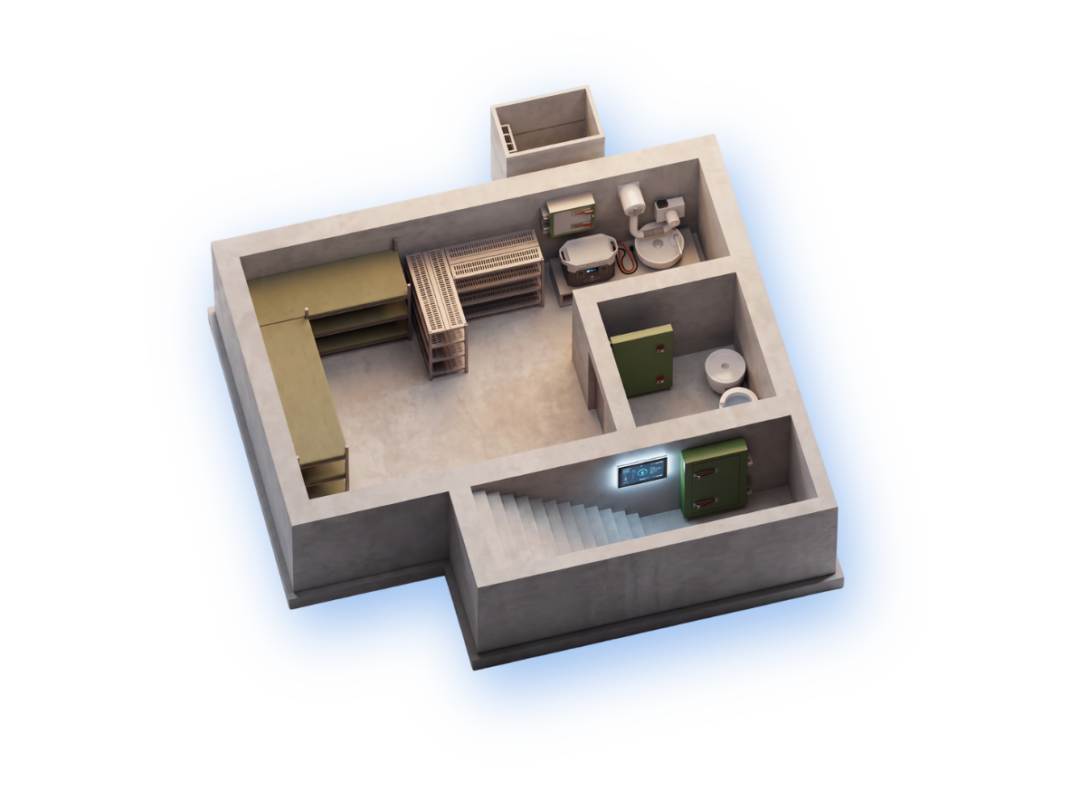
A shelter is a small, enclosed living space. Anyone who spends hours or days there needs the same things as at home: air, light, water, food, a place to sleep, and a toilet. But there’s no faucet, no electrical outlet, and no window that opens. The shelter’s amenities must make up for these things.
Berlin demonstrated in January 2026 just how quickly things can get dire without electricity. After an arson attack on a cable bridge, an estimated 100,000 people in the southwestern part of the city were without power for five days— left without heat or hot meals in the middle of winter. When you think through a situation like this, the first question that comes to mind is: What do people need in an enclosed space so they can stay there?
Three questions determine the design of a shelter. How does air get in? How do you get out in an emergency? And what do people need in the meantime?
What kind of ventilation does a shelter need?
Air is the first thing to become scarce in an enclosed space. Every person exhales carbon dioxide and moisture. The Federal Environment Agency’s guidelines indicate where the limits lie: at levels below 1,000 ppm of carbon dioxide, indoor air is considered safe; at levels above 2,000 ppm, it is considered hygienically unacceptable. In a sealed room, this level continues to rise steadily without fresh air.
There is also a second problem. The air outside may itself be contaminated—for example, by smoke from a fire, dust, or chemicals following an accident. A shelter ventilation system must therefore do two things: bring air in and purify it. You can think of the filters used for this as a gas mask for the entire room.
The room is maintained at a slight positive pressure. Wherever there is a leak, air flows out, and contaminated air stays outside. In a system like the VA 40, which serves up to 13 people, normal fresh air circulates during everyday use; in case of danger, the system switches to the GF-40 gas filter. If the power goes out, it can be operated manually. Because filters are consumables, replacement filters should be included in the planning from the start.All components are BABS-type-tested; see the questions at the end for more details.
What kinds of doors and exits does a shelter need? Why does a shelter need two exits?
A shelter must be able to be sealed off from the outside, yet it must never become a trap. This is often underestimated. If debris blocks the entrance after a fire or collapse, even the sturdiest door is useless as long as there is no second way out.
That is why every shelter must have a second exit—often a shaft in the basement or an emergency exit for basement windows. The main entrance requires a door that is appropriate for the shelter’s purpose. Depending on the requirements, pressure-rated doors or reinforced doors may be appropriate; for access from above, there is a reinforced hatch.
Why does a shelter need electricity?
Almost everything that makes a stay bearable depends on electricity: lights, the radio, chargers for cell phones and flashlights, heating in the winter, and, under normal circumstances, ventilation as well. If the public power grid fails, the room therefore needs its own emergency power source. What matters most is not so much how much electricity is available, but rather what it’s used for.
An LED light bulb, a radio, and a cell phone charger use only a few watts. A space heater is the other extreme: A 1,000-watt space heater uses as much energy in one hour as a 6-watt LED light bulb does in an entire week.
Calculating power for your own needs is simple. Capacity in watt-hours divided by the device’s power output gives you the runtime. A 1,000 Wh power station can theoretically power a 10-watt light for about 100 hours, not accounting for losses. If necessary, the fan can be operated manually. That leaves lighting, a radio, and chargers, which a power station can easily handle—for example, the EcoFlow DELTA 3 Plus (1,024 Wh). If you want more reserve capacity or a connection to your home’s power supply, go with the DELTA PRO 3, which has 4,096 Wh.
How much water and food do you need in a shelter?
A shelter does not provide supplies. These are part of the shelter’s equipment and must be stockpiled by the occupants themselves. To do this, two factors must be determined: how many people and how many days. The BBK recommends that households be able to provide for themselves for ten days if possible; even a three-day supply is therefore very helpful. For drinking water, that amounts to 2 liters per person per day, or 20 liters for ten days. A family of four would need 80 liters.
Water is best stored in collapsible canisters, which take up very little space when empty. Micropur Classic preserves clear drinking water for up to six months if the canister was filled beforehand.
When eating, it’s worth thinking about the kitchen. In an enclosed space, cooking with gas or fuel isn’t an option because any flame consumes oxygen and can release carbon monoxide. That’s why rations that don’t require cooking—such as the TREK’N EAT Day Ration Packs—are a good choice: They’re prepared directly in the pouch with water and provide about 3,000 kcal per day.
If you don’t want to buy everything separately, check out the BSSD Defense 72-Hour Emergency Kit, which bundles these items for 1 or 2 people. Our comparison will help you decide whether a kit or individual purchases is the better option.
How do you receive alerts and information in the shelter?
In everyday life, the smartphone is our primary source of information; in a shelter, it is the least reliable. Concrete walls block the signal, the battery eventually runs out, and during major power outages, the network itself can be affected: In Berlin, communications were also disrupted in some areas in January.
A hand-crank radio with DAB+ is the simple solution. It receives alerts, charges via a hand crank, solar panel, or USB-C, and features a flashlight and an SOS alarm.
What is often overlooked when equipping a shelter?
If you’re staying in the room for several days, there won’t be a pharmacy right around the corner. That’s why a first-aid kit is essential, as are any personal medications that aren’t included in a standard kit. The Pharmavoyage First Aid Pro XL contains 65 items.
Pets need the same things as people: water, food, and a designated spot. You can find the right supplies under “For Pets.”
A respirator mask helps on the way to the shelter, but it’s no substitute for room ventilation. You’ll find a selection under Respiratory Protection.
How do you sleep in a shelter?
After the first few hours, comfort matters more than you might think. People need to be able to sleep, sit, and retreat to a quiet spot every now and then. That’s not sustainable for long on a bare concrete floor, because concrete conducts heat, and anyone lying on it will get cold. Even a lounge chair or sleeping pad creates some distance from the floor.
Since space is limited, there’s a simple rule: one sleeping spot per person—for example, a shelter cot —and it should be easy to set up or put away to save space. There are also small items that make a big difference: blankets or sleeping bags, earplugs, a dimmable lamp, and something to keep you occupied—especially for children.
What kind of toilet is suitable for a shelter?
A standard toilet requires water, water pressure, and a drain. Even during a prolonged power outage, this is no longer guaranteed: Disaster relief workers point out that on higher floors, the water supply can be cut off entirely because the pumps rely on electricity. In a shelter without water or sewer connections, a different solution is needed from the outset.
The simplest option is a dry toilet: a container with a bag that doesn’t require flushing. People who stay longer want some privacy, and a toilet stall provides that. A disposable urinal takes some of the strain off the restroom, especially for larger groups.
Where do you start when equipping a shelter?
Four questions will help you organize your shopping list for shelter supplies:
- How many people? This determines the needs for ventilation, water, toilets, and sleeping arrangements.
- How many days? This determines the amount of supplies needed. The BBK recommends three days as a starting point and ten as a target.
- What is the shelter intended to protect against? This determines the filters and doors needed.
- New construction or existing building? In existing buildings, the available space determines what’s possible.
Especially with existing buildings, it’s worth taking a holistic view. ingenieur.de describes the shelter as a closed system whose vulnerabilities lie in its openings: doors, ventilation openings, and utility lines. That’s exactly where it’s determined whether the system fulfills its purpose. That’s why BSSD’s shelter assessment begins with a consultation: We discuss your situation, your requirements, and any questions you may have. During a video call, we then provide an initial assessment based on documents and photos. The initial consultation is free of charge.
You can find all products for shelter equipment in the BSSD Shop.
Frequently Asked Questions About Shelter Equipment
What equipment is included in a shelter?
Air supply with a filter, one door and a second exit, sleeping quarters, a toilet without a flush, lighting, a radio, and water and food for the planned duration. The amount of each depends on the number of people and the number of days.
Does every shelter need a filtration system?
If the room is intended to protect against airborne hazards, then yes. The GF-40 gas filter traps radioactive particles, biological contaminants, and chemical substances. Without a filter, contaminated outside air enters the room. The type of filter required depends on the protection objective.
Can a basement be converted into a shelter?
Generally speaking, yes. It depends on the design of the basement. BSSD retrofits basements with NBC filter systems, pressure-sealed doors, and structural reinforcements; our free shelter assessment will determine what options are available. Learn more under “Shelter Retrofitting.”
How long can you stay in a shelter?
This is limited by the air supply and storage capacity. The BBK specifies ten days as a planning guideline; for drinking water, this amounts to 20 liters per person. The ventilation system must be designed to last for this period, and replacement filters are part of that.
How much does it cost to equip a shelter?
Equipment and accessories have fixed prices, which are listed in the BSSD Shop. The total cost depends on the space. According to ingenieur.de, for new construction, the main cost drivers are soil surveys, permits, structural analysis, excavation safety measures, and dewatering; on top of that, there are ongoing expenses for maintenance, seals, filters, and supplies. A customized estimate takes time—about two weeks for reinforced concrete.
Are there regulations governing private shelters in Germany?
There is no specific set of regulations. Designers and manufacturers follow the guidelines issued by the Swiss Federal Office for Civil Protection (BABS). Ventilation systems and gas filters in the BSSD product line are type-tested in accordance with these guidelines.
Are there public shelters in Germany?
The Federal Office for Civil Protection and Disaster Assistance (BBK) currently counts 579 public shelters in Germany with approximately 477,593 spaces. This covers less than 1% of the population. Most of these facilities date back to the Cold War, and maintenance and upkeep were discontinued in 2007. According to the federal government, the facilities are neither operational nor ready for use.