Deutsch

Knowledge
Bunker Ventilation: How Ventilation and NBC Filter Systems Work
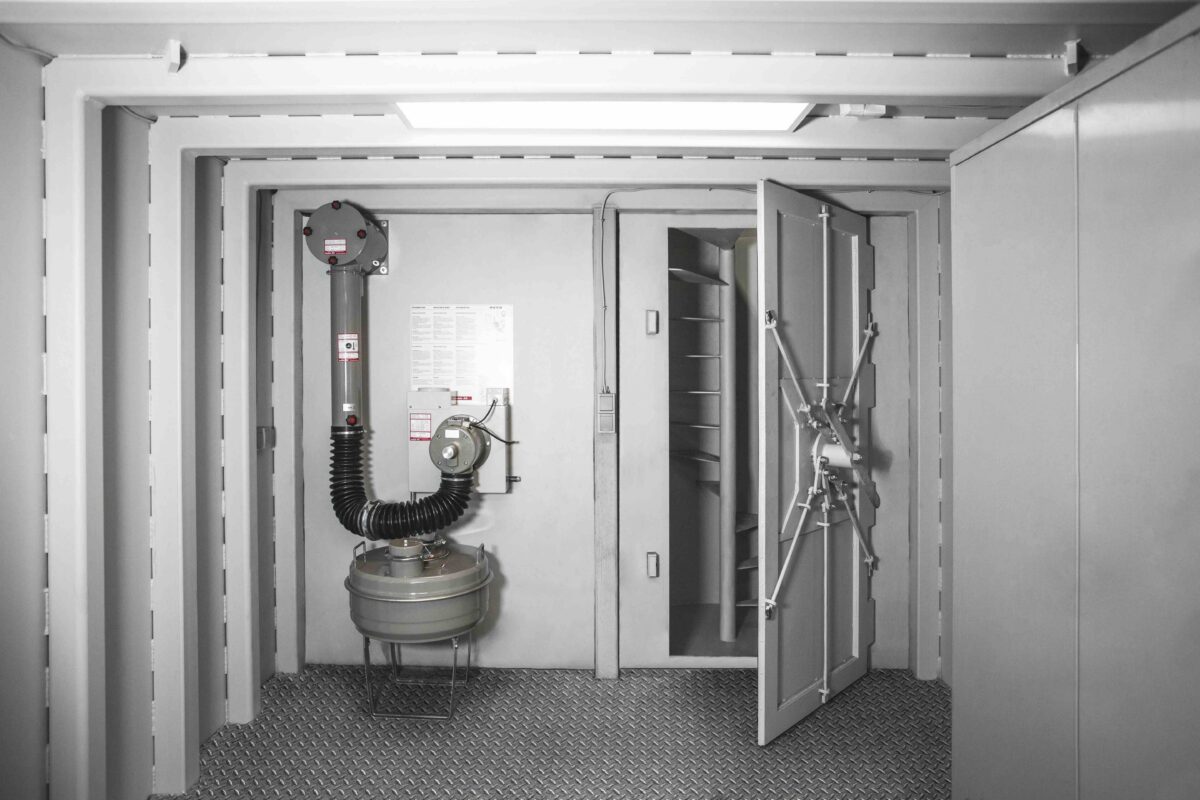
In brief: A shelter ventilation system draws in outside air, cleans it through several filter stages and pushes it into the room at a slight positive pressure. This positive pressure keeps contaminated air out, even if a joint is not perfectly airtight. If the power fails, the system can continue to be operated manually.
How does ventilation work in a bunker?
A sealed room uses up its own air. With every breath, oxygen levels decrease and CO2 levels rise. In an emergency, you cannot simply open a window, because the outside air may contain smoke, radioactive dust or toxic gas.
A ventilation system solves this in four steps. A fan draws in outside air, several filters clean it, the fan blows it into the room, and the stale air escapes outside through an explosion protection valve with positive-pressure relief.
What filters are used in an NBC filter system?
NBC stands for nuclear, biological and chemical. The system filters the air in stages. A pre-filter traps coarse dust, for example in the explosion protection valve with pre-filter. A particulate filter then captures fine particles, including radioactive dust and pathogens. An activated carbon filter binds toxic gases.
Why is positive pressure so important?
The system supplies slightly more air to the room than can escape through all the gaps. As a result, air flows from the inside to the outside through every small leak, preventing contaminated outside air from entering.
Common operating pressures range from at least 50 to a maximum of 250 pascals. This is a low pressure. That is why the airtightness of the enclosure, the door and every penetration is essential to maintaining it.
What happens during a power outage?
If the power fails, people in the shelter operate the fan manually. This requires physical effort and should be shared among several people over an extended period. The system continues supplying air to the room until power is restored.
For longer periods, it is also worth having an independent power source. BSSD offers portable EcoFlow power stations for this purpose.
What size system do you need?
The size depends on the number of places in the shelter. Conventional systems are available in three sizes: the VA 40 for up to 13 people, the VA 75 for up to 25 people and the VA 150 for up to 50 people.
The order matters: determine the number of people first, then choose the system. A system designed for 13 people cannot supply 20.
How often does the filter need to be replaced?
In peacetime, meaning while the system is not in use, the gas filter has a shelf life of 30 years. The coarse filter is compatible with the VA 40, VA 75 and VA 150, costs from €220 and can be installed yourself.
Can you build a shelter ventilation system yourself?
Technically, it is possible to connect a fan to a filter. However, this does not guarantee reliable protection. The result depends on every stage having been tested and verified: filter performance, airtight connections, positive pressure and emergency operation. With a DIY system, no one can guarantee these values, and you will no longer be able to check them when an emergency occurs.
What components are part of the system?
A filter system only works in combination with the rest of the shelter. This includes valves, such as the explosion protection valve, and an airtight shelter door. An air heater is also available for the VA 75 and VA 150.
If you want to control everything from one place, you can use the intelligent building control system. It controls the NBC filter system, lighting and sensors via tablet, smartphone or PC, optionally with an LTE emergency connection.
What should you check before buying?
- Is the system designed for the number of people you need to accommodate?
- Does it continue operating during a power outage?
- Have the filters and the system been type-tested?
- Are the door, valves and penetrations compatible with the system?
- How long does the filter last, and how do you replace it?
Frequently Asked Questions About Bunker Ventilation
How much does a bunker ventilation system cost?
At BSSD, a bunker ventilation system starts at €5,990 (VA 40). An individual gas filter (GF-40) is available from €3,189.
What filter system does a shelter need?
Specialised NBC filter systems are used to protect against certain chemical, biological and radioactive hazards. The appropriate system depends, among other things, on the room size, intended use and required level of protection.
How does a gas filter system work in a bunker?
A gas filter system cleans the incoming outside air of certain contaminants. In a suitable shelter system, the filtered air is directed into the room. Controlled positive pressure can also help prevent unfiltered air from entering through leaks.
How long does an NBC filter for a bunker last?
The service life of an NBC filter depends, among other things, on the type and concentration of contaminants, the air volume and the operating conditions. In peacetime, an unopened filter has a shelf life of 30 years.
Can a shelter ventilation system be installed retrospectively?
Yes. Under certain conditions, a shelter ventilation system can be retrofitted in an existing basement or shelter. Important factors include the airtightness of the room, the possibility of supplying outside air and the structural conditions.
Can you build a shelter ventilation system yourself?
A basic ventilation system is not equivalent to a tested shelter ventilation system. To protect against hazardous substances, the filters, airflow, airtightness and, where necessary, positive-pressure maintenance must be coordinated. A self-built solution does not automatically provide comparable protection.
Buy a Bunker Filter System
Are you looking for bunker ventilation or an NBC filter system for your shelter? Discover the suitable filter systems and components from BSSD.